
Login or create an account
CloseReturning Customer
I am a returning customer
Login or create an account
CloseRegister Account
If you already have an account with us, please login at the login form.
Your Account Has Been Created!
Thank you for registering with buypeptidesbest!
You will be notified by e-mail once your account has been activated by the store owner.
If you have ANY questions about the operation of this online shop, please contact the store owner.
Account Logout
You have been logged off your account. It is now safe to leave the computer.
Your shopping cart has been saved, the items inside it will be restored whenever you log back into your account.
| Unit Size | 5 mg/vial |
| Unit Quantity | 1 vial |
| Purity (Mass Spectrometry and UV) | 99.79% |
| Sequence | H-Gly-Glu-Pro-Pro-Pro-Gly-Lys-Pro-Ala-Asp-Asp-Ala-Gly-Leu-Val-OH |
| Molecular Formula | C62H98N16O22 |
| Appearance | Lyophilized White Powder |
| Source | Chemical Synthesis |
| Storage | Lyophilized BPC 157 is Stable at room Temperature for 90 days, however it is best to store in a freezer below - 8c for any extended period of time. |
| Terms | The products we offer are intended for laboratory research use only. Please familiarize yourself with our terms of service prior to ordering. |
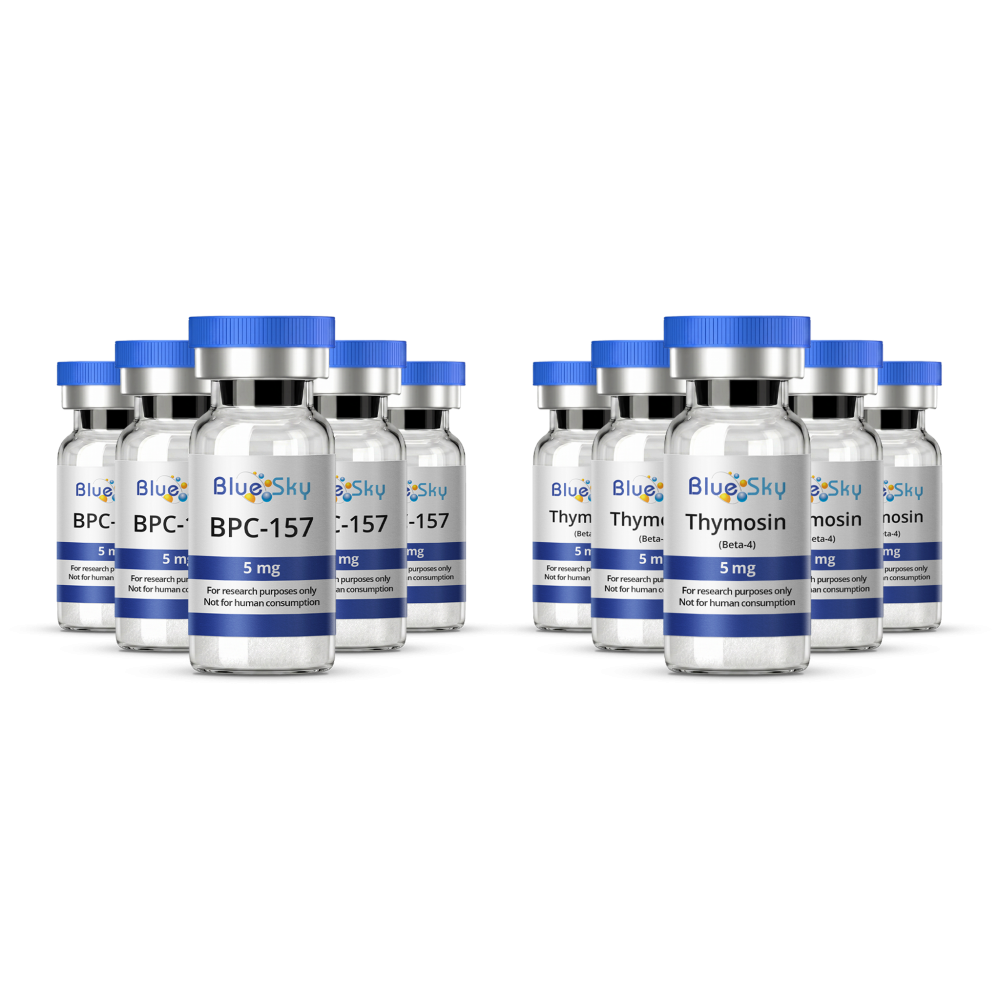
This bundle pairs five individually-supplied vials of BPC-157 (5mg) with five individually-supplied vials of Thymosin Beta 4/TB-500 (5mg), for researchers who want both peptides on hand without committing to a fixed mixing ratio.
Independent Verification Versus a Pre-Mixed Formulation
Because each vial in this bundle contains a single peptide rather than a blended formulation, each is independently verified by HPLC and mass spectrometry against its own single-compound specification, without the added analytical step of confirming a fixed ratio between two co-formulated peptides.
This differs from a pre-mixed blend, where the two peptides would instead be combined into a single formulation at a fixed, manufacturer-set ratio.
Thymosin Beta 4 (TB-500) Actin-Binding Research
Thymosin Beta 4 functions as the principal G-actin sequestering peptide in the cytoplasm, forming a 1:1 complex with monomeric actin that inhibits its polymerization into filaments, a mechanism studied in laboratory research on cell migration and differentiation.1
BPC-157 Structural Considerations
BPC-157 is a synthetic pentadecapeptide originally derived from a protein found in human gastric juice, distinguished by an unusually high proline content across roughly a quarter of its fifteen residues.
This proline-dense backbone is understood to impose conformational rigidity, a structural feature researchers have linked to the peptide's reported resistance to enzymatic degradation in laboratory assay systems.
Combined Research Applications
Because BPC-157 and Thymosin Beta 4 are studied for distinct cell signaling mechanisms, cytoskeletal actin dynamics for the latter, receptor-independent signaling for the former, researchers may study them side by side to examine multiple pathways within the same experimental model.
Data specific to combined use of these two peptides remains limited, and any such research should be treated as exploratory.
Analytical Verification for Bulk Vial Quantities
With five vials of each peptide supplied together, researchers are encouraged to confirm that certificates of analysis are available for each individual vial or production lot, since synthesis batches can vary even under the same nominal specification.
Storage and Handling in the Laboratory Setting
Both peptides are best kept lyophilized under sub-zero freezer conditions until shortly before use, since peptide bonds become more susceptible to hydrolysis and oxidative breakdown once removed from this stable, freeze-dried state.
With ten vials to manage across this bundle, keeping them organized by peptide and batch simplifies tracking which vials have been opened versus those still sealed in storage.
Important Notice
BPC-157 and Thymosin Beta 4 (TB500) are strictly for in vitro laboratory research purposes only and are not intended for human consumption. These findings do not establish safety, efficacy, or suitability for any human application, and these products have not been evaluated by the FDA or any regulatory agency.
Product Information
This bundle includes 5 vials of BPC-157 at 5mg per vial and 5 vials of Thymosin Beta 4 (TB500) at 5mg per vial, supplied as lyophilized powders for laboratory research use only.
References
1. Huff T, Müller CS, Otto AM, Netzker R, Hannappel E. Beta-Thymosins, small acidic peptides with multiple functions. Int J Biochem Cell Biol. 2001 Mar;33(3):205-20.